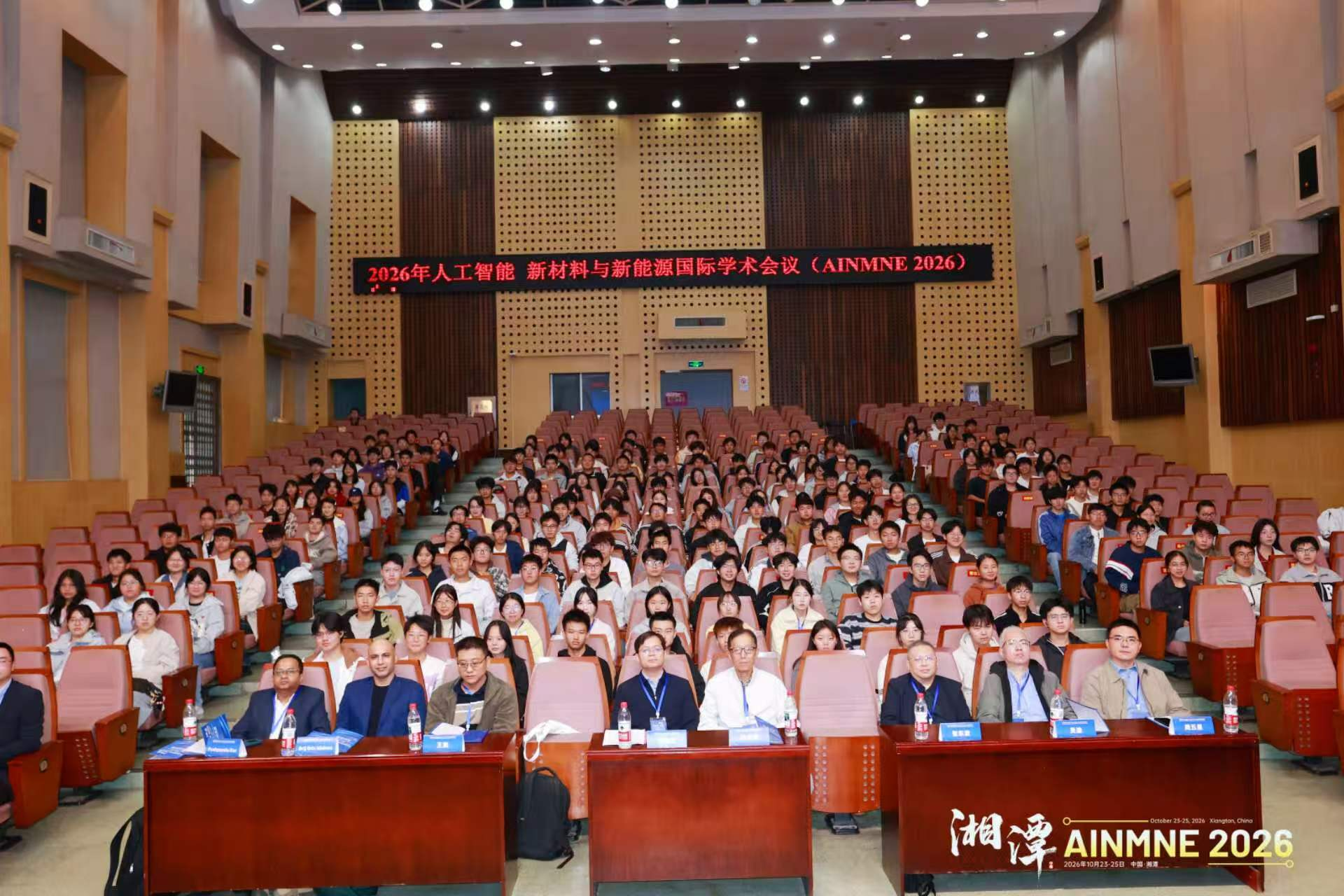
From October 23 to 25, the 2026 International Conference on Artificial Intelligence, New Materials and New Energy (AINMNE 2026) was held at our university. The conference was hosted by our university, organized by the School of Information Science and Engineering, the School of Future Technology, and Hunan Provincial Talent Group, guided by the Xiangtan Association for Science and Technology, and co-organized by several universities including Hunan University of Science and Technology and Hengyang Normal University. It attracted over 100 experts, scholars, faculty and student representatives from Peking University, the University of Lisbon in Portugal, and other institutions at home and abroad for offline exchange.
At the opening ceremony, Vice President Ding Xuanming delivered remarks. He welcomed the domestic and international experts and scholars in attendance and introduced the university’s discipline development. He noted that the conference focuses on the interdisciplinary frontiers of artificial intelligence, new materials, and new energy, aiming to build a high-level academic exchange platform, promote interdisciplinary innovation and collaboration, and facilitate the translation of technological outcomes and industrial upgrading in related fields.
During the conference, several renowned experts delivered keynote speech. Wang Kai, professor at Qingdao University; Brij Mohan, professor at the University of Lisbon; Zhang Dongbo, professor at Xiangtan University; Pushpendu Kar, professor at the University of Nottingham-Ningbo; Zhou Wuxing, professor at Hunan University of Science and Technology; and Thippa Reddy Gadekallu, professor at Zhejiang Agriculture & Forestry University, shared their latest research on topics including supercapacitor health diagnosis, MOF functional composites, embodied active visual perception, intelligent traffic prediction, thermal transport in energy materials, and Healthcare 5.0 agentic AI. The conference also featured oral presentation and poster sessions, where young researchers from universities and research institutions across the province and beyond conducted academic discussions on themes such as silicon-based anodes, perovskite thin films, and molecular simulation of insulating oil. Participants engaged in thorough exchange of ideas and sparked new research inspiration.
The conference further expanded our university’s academic ties with universities and research institutions at home and abroad and enhanced the university’s external influence in the interdisciplinary fields of artificial intelligence, new materials, and new energy. Taking this as an opportunity, our university will continue to advance interdisciplinary integration and international exchange and cooperation, deepen collaborative innovation among industry, academia, and research, and contribute to local scientific and technological progress and industrial development.
(Reviewed by Wang Jiayi, Wang Liyang)


 Home